A Dialogue Beyond Words with Humpback whales (part 1)
This blog post provides a deeper scientific exploration of the poetry shared on Instagram. You can view the original work, "A Dialogue Beyond Words with Humpback Whales", a fusion of photography and poetry, at the link below.
現在、日本語版が上手く表示されない可能性があります。
Noteにて、近日中に日本語版の掲載を予定しております。もし宜しければフォローしてお待ちいただけたら嬉しいです。
The ocean is the cradle of all life, yet more than 80% of its vastness remains unmapped. It is a "terra incognita" that holds the secrets of our origins. In Northern California, where the cold, nutrient-rich Pacific meets the rugged coastline, I witnessed a phenomenon that dissolved the boundary between data and spirit.
It was a rare day. The fog had lifted, and the wind was still. In this silence, I felt a low-frequency vibration resonate within my marrow. This is the domain of Acoustic Ecology, the study of how living beings relate to their environment through sound. Humpback whales (Megaptera novaeangliae) are masters of the SOFAR Channel (Sound Fixing and Ranging channel), a deep-sea layer that acts as a natural waveguide, allowing low-frequency sounds to travel thousands of miles.
When I whispered, "We came to see you," and felt the response "We were waiting," it wasn't a hallucination. It was a synchronicity of consciousness, a moment where the observer and the observed became a single biological system. As Roger Payne, the biologist who first discovered whale songs, noted in Among Whales, these songs are not just noise; they are complex, evolving cultural expressions of an ancient intelligence.
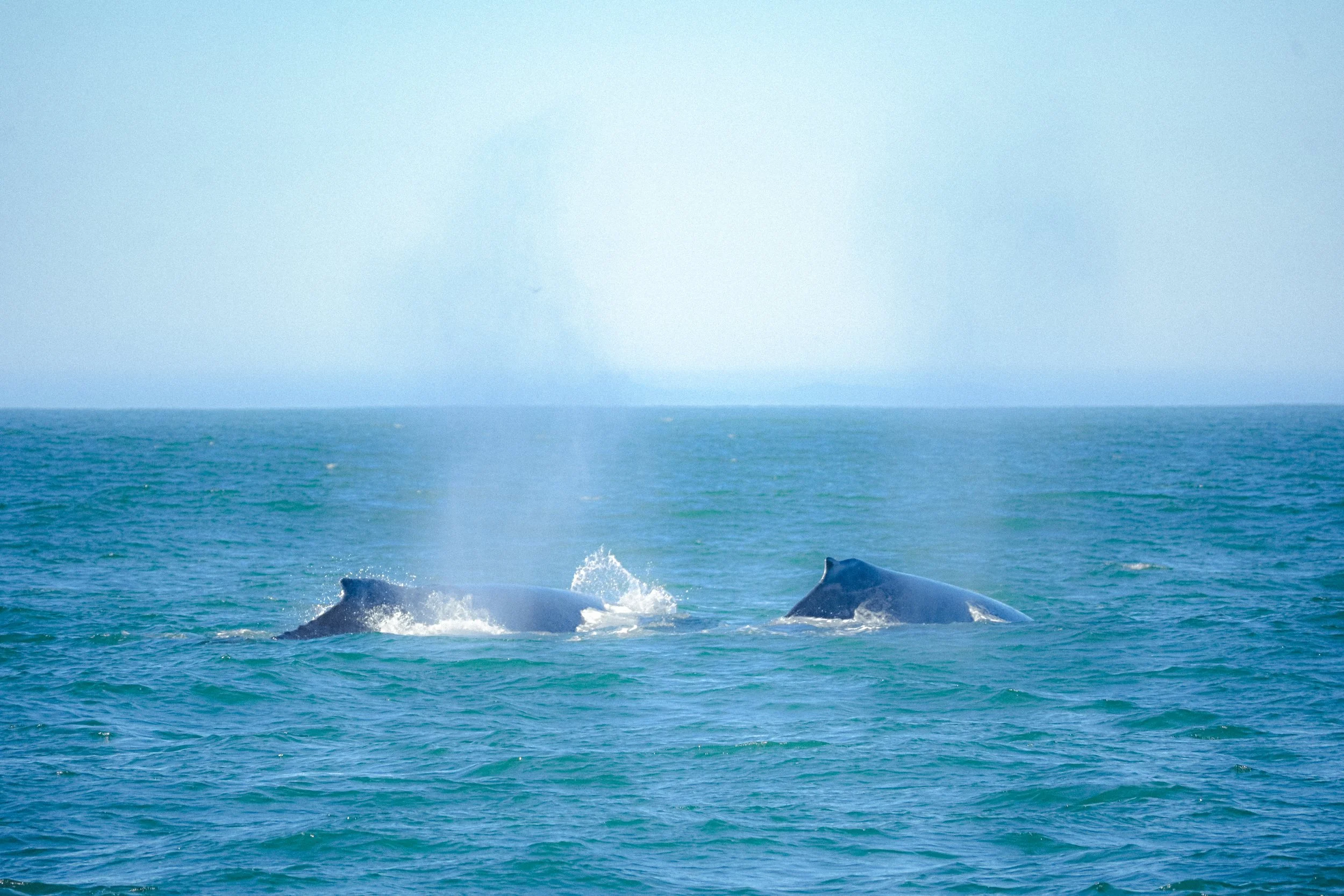
Five minutes later, three majestic forms broke the surface. As they circled our boat, a powerful, pungent scent filled the air. This was the smell of the "Whale Pump." Whales act as ecological engineers. By feeding in the depths and excreting near the surface, they transport essential nutrients such as iron, nitrogen, and phosphorus back into the "photic zone" (the sunlit top layer where photosynthesis can happen). Think of them as the gardeners of the sea, fertilizing the phytoplankton that generate over 50% of the oxygen in our atmosphere. As researcher Joe Roman details in his 2014 study, "Whales as marine ecosystem engineers," their existence is a literal life-support system for the planet. To stand in their presence is to stand at the very source of the air we breathe.
When the mother whale whispered, "When we sing freely, the seas thrive," she was stating a biological truth: whales are the keystones that prevent the entire oceanic food web from collapsing.
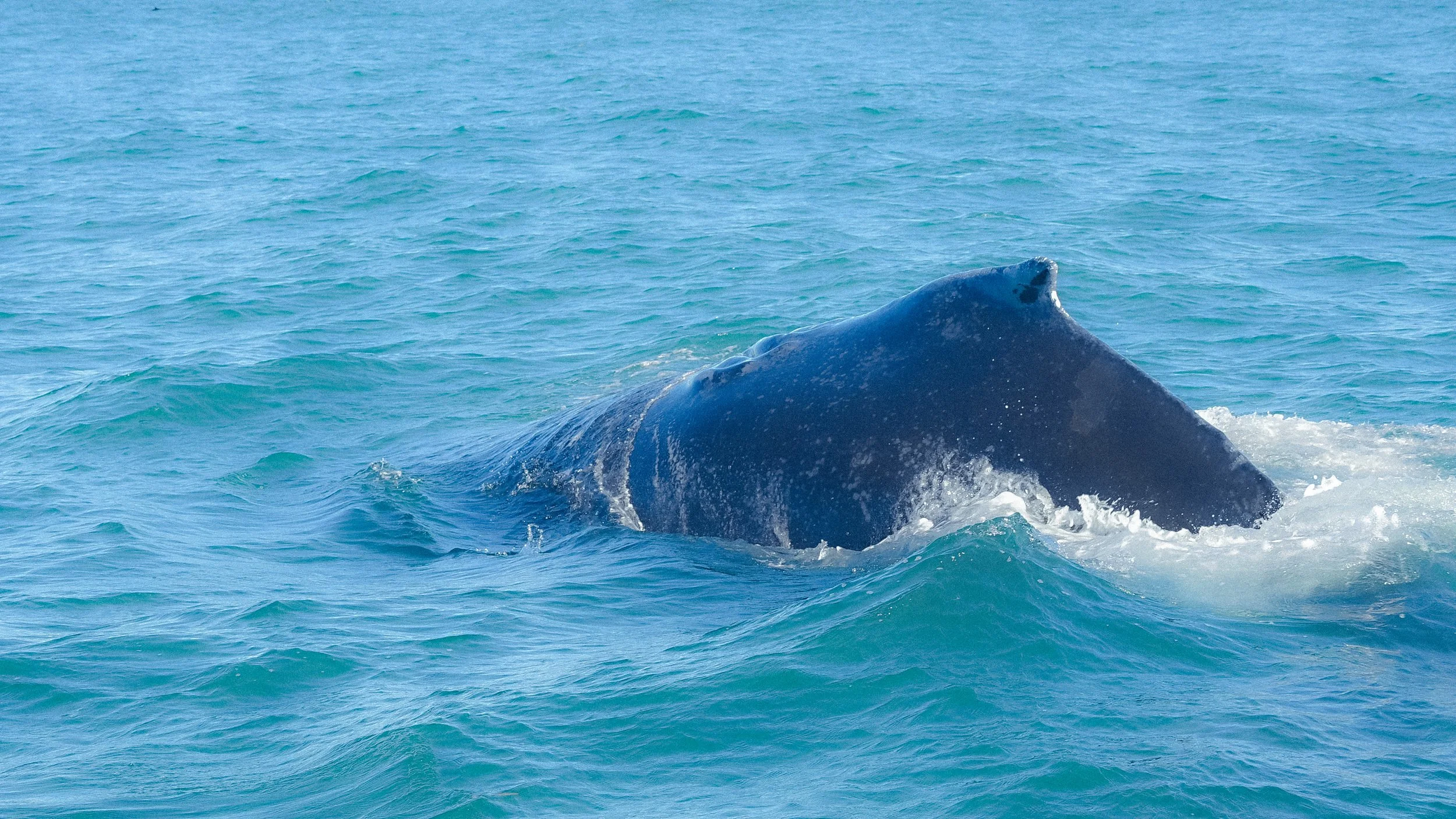
Perhaps the most profound mystery is their capacity for Interspecies Altruism. Biologist Robert Pitman published a groundbreaking study in Marine Mammal Science (2016), documenting over 100 incidents of humpbacks intervening in orca attacks to protect seals, sunfish, and other whale species. In one instance, they fought for over seven hours to save a weaker animal.
This behavior defies simple "survival of the fittest" logic. It suggests a complex moral agency or a trans-species social bond. When the mother whale said, "Humans... if you were attacked, we would protect you," it wasn't anthropomorphism. It was a declaration of a universal kinship. The message she delivered: "You are a perfect part of this Earth", is a biological reality. In the intricate web of life, every niche is essential. You do not have to "become" something to have value; your existence is your function.
As they dove deep, raising their massive tail flukes, which are individual identifiers as unique as a human fingerprint, I realized that this dialogue with the humpback whales is, in essence, a journey into the self. To engage with their ancient wisdom is to discover the hidden depths of my own being. Every sound they emit, and every silence we share, serves as a mirror reflecting the landscape of my own soul.
Our connection to these "Engineers of the Deep" transcends the need for external protection. It is a matter of resonance. I have come to believe that our path to a flourishing ocean begins with our own internal restoration. When we find the stillness within and begin to heal our own hearts, that healing ripples outward, naturally contributing to the healing of the seas.
We do not simply save the whales; we remember our shared rhythm. By returning to a state of wholeness within ourselves, we align with the life-support system that sustains us all. When we listen to the whales, we do not just learn about another species. We remember how to be truly human.
[References]
Payne, R. (1995). Among Whales. Scribner.
Roman, J., et al. (2014). "Whales as marine ecosystem engineers". Frontiers in Ecology and the Environment.
Pitman, R. L., et al. (2016). "Humpback whales interfering when mammal-eating killer whales attack other species: Mobbing behavior and interspecific altruism?". Marine Mammal Science.
Payne, R., & McVay, S. (1971). "Songs of Humpback Whales". Science.
